> For the complete documentation index, see [llms.txt](https://docs.avonnicomponents.com/llms.txt). Markdown versions of documentation pages are available by appending `.md` to page URLs; this page is available as [Markdown](https://docs.avonnicomponents.com/dynamic-components/components/button-group.md).

# Button Group

The Button Group component combines multiple buttons into a single cohesive unit, organizing related actions in a compact, user-friendly layout. Use it whenever you want to present a set of related actions — such as toolbar commands or form actions — together.

## Overview

A Button Group lets you define any number of buttons, each with its own label, icon, variant, and visibility state. You can arrange the buttons in a compact group or spaced out in a row, and — when you have more actions than space allows — move the overflow buttons into a dropdown menu to keep the interface clean.

**Why use the Button Group component?**

* **Organize actions:** Group related actions together for a more intuitive user experience.
* **Improve visual appeal:** Present buttons in a consistent, organized manner.
* **Optimize space:** Use the overflow menu to manage many buttons without cluttering the interface.
* **Enhance consistency:** Maintain a uniform style and layout for buttons across your application.

## Configuration

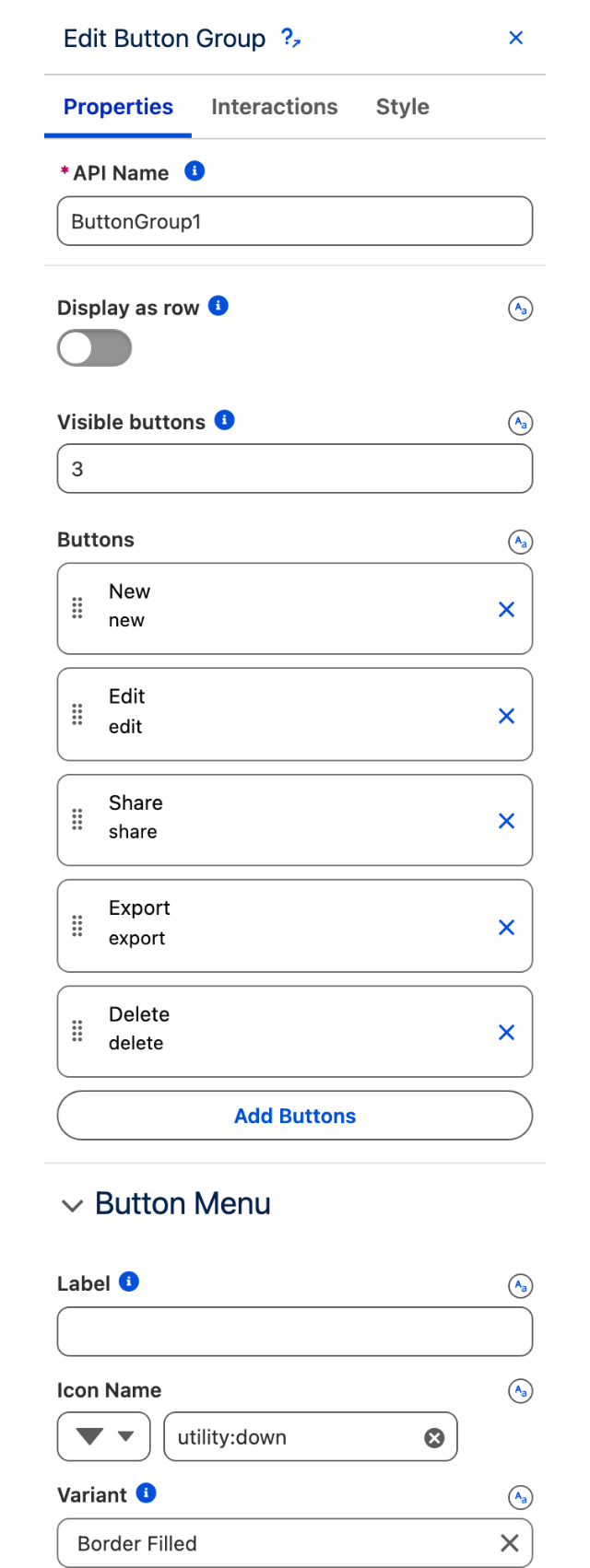
To configure the Button Group, select it on the canvas. The **Edit Button Group** panel opens on the right with three tabs: **Properties**, **Interactions**, and **Style**. The sections below mirror the Properties tab.

### Properties

#### Display as Row

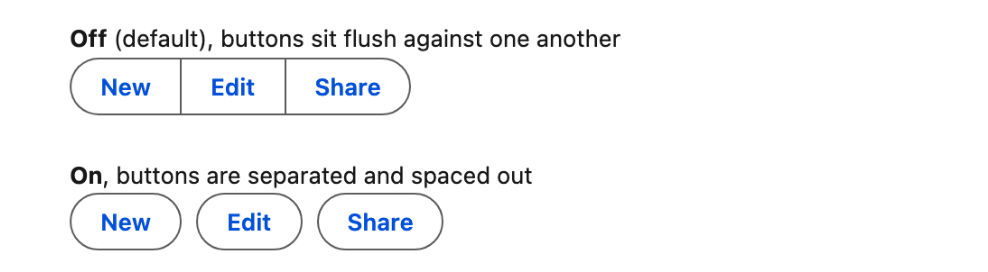
When enabled, the buttons are rendered as separated items spaced out in a row, instead of the default compact grouped layout where buttons sit flush against one another.

#### Visible Buttons

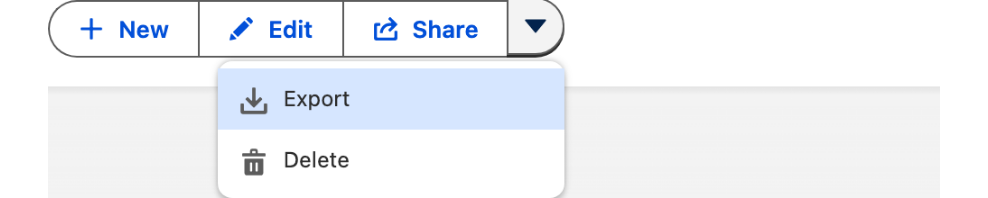
Sets the maximum number of buttons to display. Any buttons beyond this count are moved into the overflow button menu (configured below). If left unset, all buttons are displayed.

#### Buttons

Add and order the buttons that make up the group. Each button exposes the following settings:

| Setting           | Description                                                                                                   |
| ----------------- | ------------------------------------------------------------------------------------------------------------- |
| **Label**         | The text displayed on the button.                                                                             |
| **Icon Name**     | A Lightning Design System icon to display on the button.                                                      |
| **Icon Position** | Where the icon sits relative to the label — **Left** (default) or **Right**. Applies once a label is set.     |
| **Icon Source**   | A custom image URL to use as the button icon instead of a Lightning icon.                                     |
| **Variant**       | Changes the appearance of the button. Defaults to **Neutral**. See the variant list below.                    |
| **Disabled**      | Prevents the button from being clicked.                                                                       |
| **Hidden**        | Hides the button from the group.                                                                              |
| **Title**         | Tooltip text shown when hovering over the button.                                                             |
| **Name**          | A unique identifier for the button within the group. Required, and used to target the button in interactions. |

The **Variant** options are: Bare, Bare Inverse, Base, Border, Border Filled, Border Inverse, Brand, Brand Outline, Container, Destructive, Destructive Text, Inverse, Neutral, and Success.

### Button Menu

The Button Menu section configures the overflow dropdown that appears when **Visible Buttons** limits how many buttons are shown. Any buttons beyond the visible count are collected into this menu.

| Setting            | Description                                                                                             |
| ------------------ | ------------------------------------------------------------------------------------------------------- |
| **Label**          | The text displayed on the menu button that opens the dropdown.                                          |
| **Icon Name**      | A Lightning Design System icon to display on the menu button.                                           |
| **Variant**        | Changes the appearance of the menu button. Defaults to **Border Filled**.                               |
| **Menu Alignment** | The horizontal alignment of the dropdown relative to the menu button — **Left** or **Right** (default). |

The menu button **Variant** options are: Bare, Bare Inverse, Border, Border Filled, Border Inverse, Brand, Brand Outline, Container, Destructive, Destructive Text, Inverse, Neutral, and Success.

### Set Component Visibility

All components support conditional visibility — see [Component Visibility](/dynamic-components/core-concepts/component-visibility.md).

## Use Cases

* **Toolbar:** Create a toolbar with buttons for common actions like New, Edit, Delete, and Save.
* **Navigation:** Group navigation buttons together for easy access to different sections of your application.
* **Form Actions:** Combine Submit and Cancel buttons in a visually cohesive unit.
* **Workflow Actions:** Present a set of actions related to a specific workflow or process.

## Interactions

[Interactions](/dynamic-components/component-builder/interactions.md) define what happens when users interact with the Button Group. Configure them from the **Interactions** tab of the Edit Button Group panel.

### Click

Fires when a user clicks a button in the group. Use the **targetName** output to identify which button was clicked (matched against the button's **Name**) and branch your flow logic accordingly.

## Styling

The Button Group offers extensive styling options to help you integrate it into your Salesforce environment. Configure them from the **Style** tab of the Edit Button Group panel.

{% tabs %}
{% tab title="Margin" %}
Controls the *outer* spacing around the button group.

* **Top / Right / Bottom / Left:** Adjust the space on each side of the group.
  {% endtab %}

{% tab title="Padding" %}
Controls the *inner* spacing inside the button group container.

* **Top / Right / Bottom / Left:** Adjust the inner spacing on each side.
  {% endtab %}

{% tab title="Border" %}
Customizes the border surrounding the button group.

* **Color / Size / Style / Radius:** Customize the group border.
  {% endtab %}

{% tab title="Horizontal Alignment" %}

* **Horizontal Alignment:** Align the button group within its container.
  {% endtab %}

{% tab title="Container" %}

* **Background Color:** Set the background color of the group container.
  {% endtab %}

{% tab title="Label" %}

* **Font Size / Font Style / Font Weight / Font Family:** Customize the typography of the button labels.
  {% endtab %}

{% tab title="Buttons Border" %}

* **Size / Style:** Adjust the border size and line style applied to the buttons.
  {% endtab %}

{% tab title="Variants" %}
Each button variant has its own color group (set per variant: **Bare**, **Bare Inverse**, **Base**, **Border**, **Border Filled**, **Border Inverse**, **Brand**, **Brand Outline**, **Container**, **Destructive**, **Destructive Text**, **Inverse**, **Neutral**, **Success**).

* **Background Color, Text Color, Border Color:** Customize each across the default, active, and hover states of buttons using that variant.
  {% endtab %}
  {% endtabs %}

## Output Variables

The Button Group exposes this output variable you can reference elsewhere on the page after the user interacts with it.

### Button Click

When a user clicks a button in the group, this variable updates with the clicked button's identity.

| Output variable         | Type          | What it returns                              |
| ----------------------- | ------------- | -------------------------------------------- |
| **Clicked Button Name** | Text (String) | The **Name** of the button the user clicked. |

> **Example:** When a user clicks a button named `delete`, use **Clicked Button Name** to conditionally show a confirmation dialog component on the same page.


---

# Agent Instructions
This documentation is published with GitBook. GitBook is the documentation platform designed so that both humans and AI agents can read, navigate, and reason over technical content effectively. Learn more at gitbook.com.

## Querying This Documentation
If you need additional information that is not directly available in this page, you can query the documentation dynamically by asking a question.

Perform an HTTP GET request on the current page URL with the `ask` query parameter, and the optional `goal` query parameter:

```
GET https://docs.avonnicomponents.com/dynamic-components/components/button-group.md?ask=<question>&goal=<endgoal>
```

`ask` is the immediate question: it should be specific, self-contained, and written in natural language.
`goal` is optional and describes the broader end goal you are ultimately trying to accomplish on behalf of the user. GitBook uses it to tailor the answer towards what is most useful for that goal.

The response will contain a direct answer to the question and relevant excerpts and sources from the documentation.

Use this mechanism when the answer is not explicitly present in the current page, you need clarification or additional context, or you want to retrieve related documentation sections.