> For the complete documentation index, see [llms.txt](https://docs.avonnicomponents.com/llms.txt). Markdown versions of documentation pages are available by appending `.md` to page URLs; this page is available as [Markdown](https://docs.avonnicomponents.com/dynamic-components/component-builder/advanced-features/undo-redo.md).
# Undo / Redo
The Avonni Dynamic Component Builder provides standard Undo and Redo functionality, allowing you to quickly reverse and reapply actions you've taken while designing your components. This makes it safe to experiment and iterate on your buildings without fear of losing work.
***
## How it Works
* **Undo:** Reverts the *last* action you performed. This includes actions like:
* Adding a component.
* Deleting a component.
* Moving a component.
* Changing a component's properties (e.g., label, data source, interactions).
* Modifying data source filters or queries.
* Creating, deleting or modifying a resource.
* **Redo:** Re-applies an action that you *undid*. Redo is only available immediately after an Undo operation.
***
## Location
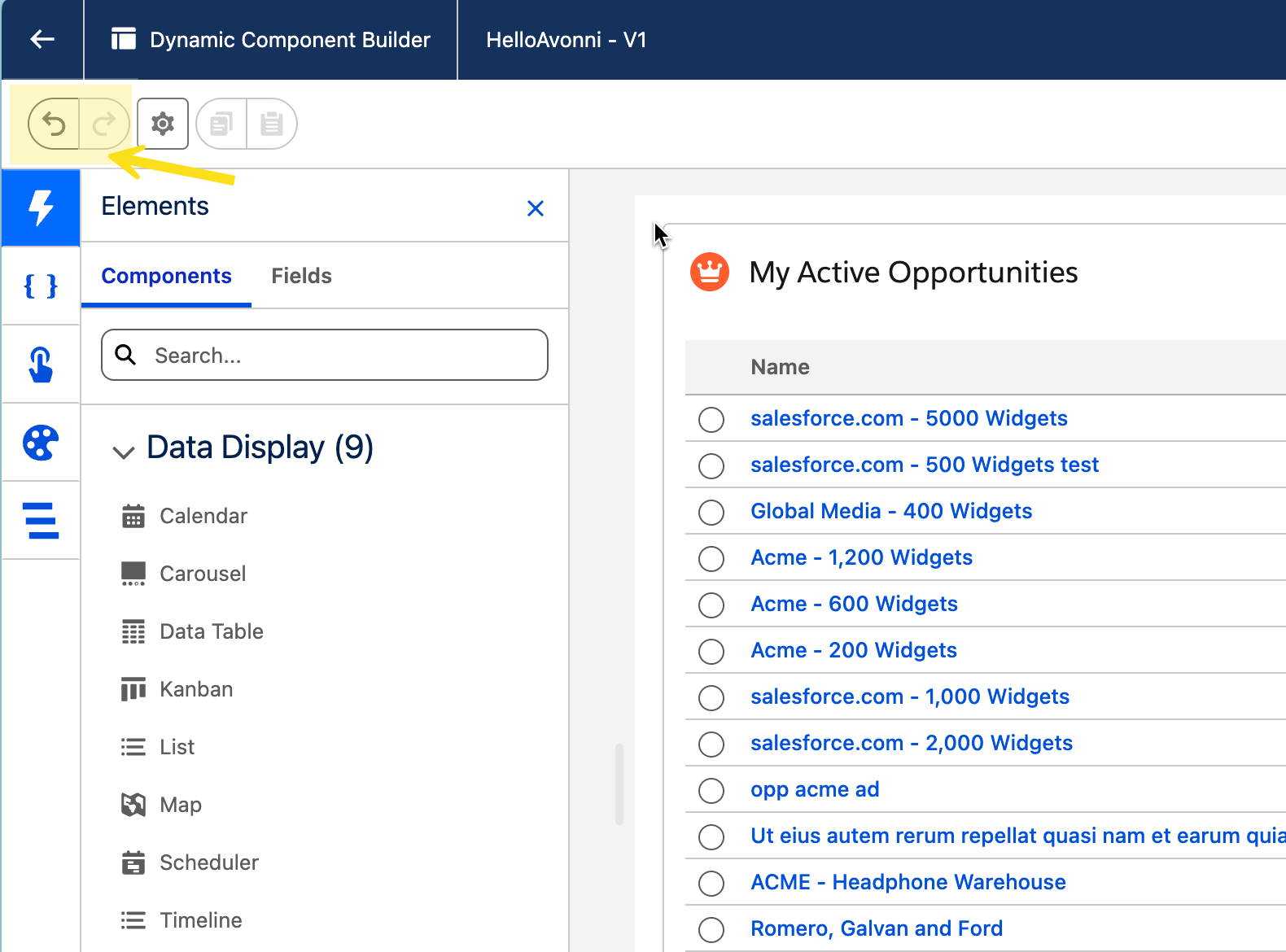
The Undo and Redo buttons are located in the top-left corner of the Dynamic Component Builder canvas. Curved arrow icons typically represent them:
* **Undo:** An arrow curving to the left (often with a counter-clockwise direction).
* **Redo:** An arrow curving to the right (often with a clockwise direction).
***
## Usage
1. **Undo:** To reverse your most recent action, click the Undo button (or use the keyboard shortcut, usually Ctrl+Z or Cmd+Z). You can repeatedly click Undo to step back through multiple actions.
2. **Redo:** If you Undo an action and then want to re-apply it, click the Redo button (or use the keyboard shortcut, usually Ctrl+Y, Cmd+Y, or Ctrl+Shift+Z).
---
# Agent Instructions
This documentation is published with GitBook. GitBook is the documentation platform designed so that both humans and AI agents can read, navigate, and reason over technical content effectively. Learn more at gitbook.com.
## Querying This Documentation
If you need additional information that is not directly available in this page, you can query the documentation dynamically by asking a question.
Perform an HTTP GET request on the current page URL with the `ask` query parameter, and the optional `goal` query parameter:
```
GET https://docs.avonnicomponents.com/dynamic-components/component-builder/advanced-features/undo-redo.md?ask=&goal=
```
`ask` is the immediate question: it should be specific, self-contained, and written in natural language.
`goal` is optional and describes the broader end goal you are ultimately trying to accomplish on behalf of the user. GitBook uses it to tailor the answer towards what is most useful for that goal.
The response will contain a direct answer to the question and relevant excerpts and sources from the documentation.
Use this mechanism when the answer is not explicitly present in the current page, you need clarification or additional context, or you want to retrieve related documentation sections.