> For the complete documentation index, see [llms.txt](https://docs.avonnicomponents.com/llms.txt). Markdown versions of documentation pages are available by appending `.md` to page URLs; this page is available as [Markdown](https://docs.avonnicomponents.com/flow/tutorials/interactions/how-to-pass-an-input-variable-from-one-flow-to-another.md).
# How to pass an Input Variable from One Flow to Another
## Overview
This step-by-step tutorial will show you how to pass an input variable from one flow to another. This involves creating and configuring variables in both flows and ensuring correct interaction with the Avonni Components Open Flow Dialog.
**Scenario:** You have a flow that displays a list of Accounts in a data table. When a user clicks a button on an Account row, a flow dialog shows the related Contacts for that Account.
{% hint style="success" %}
Want to smoothly integrate content from another flow into your current screen flow? [**The Open Flow Panel interaction**](/flow/component-builder/interactions-panel/open-flow-panel.md) lets you display that content seamlessly within a panel, creating a more intuitive and user-friendly experience.
{% endhint %}
***
## **Step 1: Prepare the Target Flow**
1. **Go to the Target Flow**
* If you already have a flow you want to use as your target flow, open it in Flow Builder.
* If you need to create a new flow to serve as the target, create a new screen flow in Flow Builder.
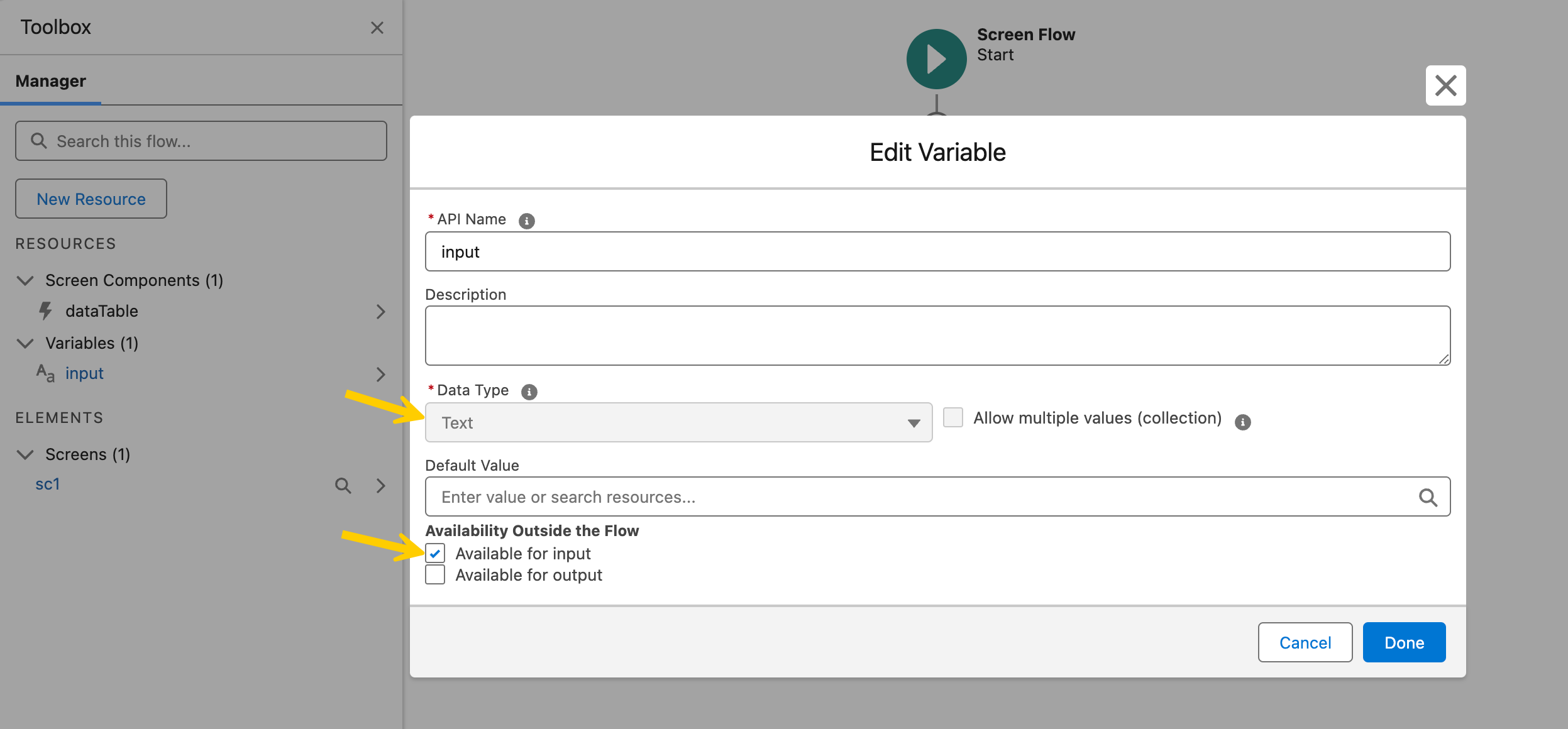
2. **Create a New Variable Element:** Add a new variable element to this target flow. This variable will hold the value passed from the first flow.
3. **Choose the Variable Type:**
* **Text Variable:** Select this if you pass textual information or alphanumeric values.
* **Record Variable:** Use this to pass an entire record with its associated field values.
4. **Configure the Variable for Input:** Crucially, ensure this variable is available for **input**. This setting ensures that the variable can receive a value passed from the Open Flow Dialog interaction in the first flow.
***
## **Step 2: Configure the Open Flow Dialog in the First Flow**
### **Open the Open Flow Dialog Interaction**
In the *first* flow (the one initiating the process), locate the Avonni Components Open Flow Dialog interaction element. You'll configure this element to open the target flow.
### **Configure the Input Variable**
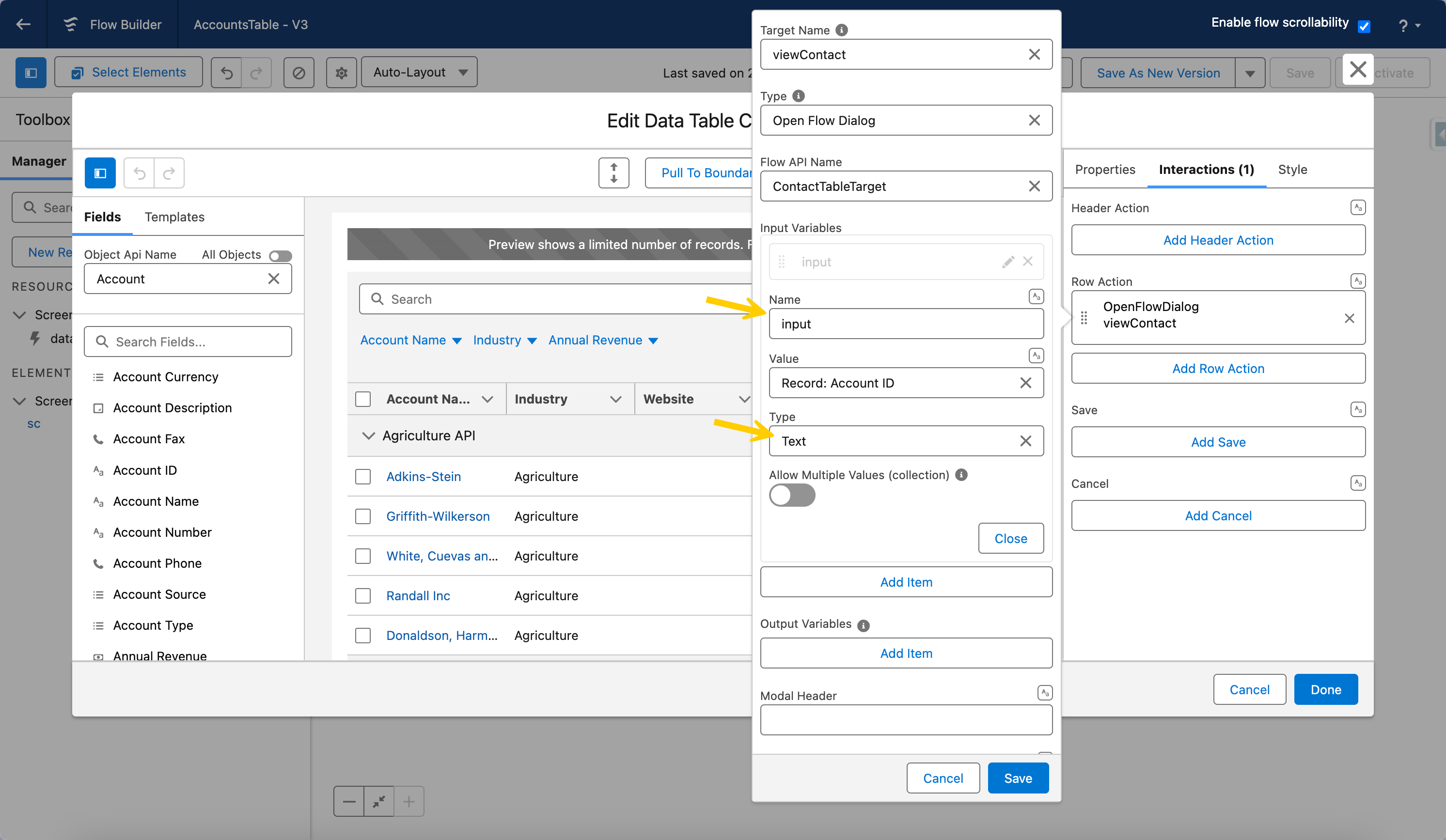
* **Click "Input Variable":** Within the Open Flow Dialog interaction settings, find and click the "Input Variable" button. This will allow you to specify a variable to pass to the target flow.
* **Enter the Variable Name:** In the provided field, carefully enter the exact name of the input variable you created in Step 1 in the *target* flow. Accuracy is crucial here to ensure the correct variable is populated.
* **Select the Value to Pass:** Choose the specific value you want to send to the target flow. This could be a literal value (like "Hello"), a formula, or a field reference like a record id.
* **Choose the Value Type:** Indicate the data type of the value you pass (Text, Boolean, Date, etc.). This helps ensure compatibility between the flows.
{% hint style="danger" %}
Ensure that the input name matches the name of the variable element created in Step 1 above.
{% endhint %}
***
## **Step 3: Displaying Data in the Target Flow**
### **Configure the Screen Element:**
* In your target flow, you'll likely have a screen element to display information (like a data table, list view, or display text).
* Configure this element to show the relevant data based on the input variable you received from the first flow.
### **Example: Filtering a Data Table**
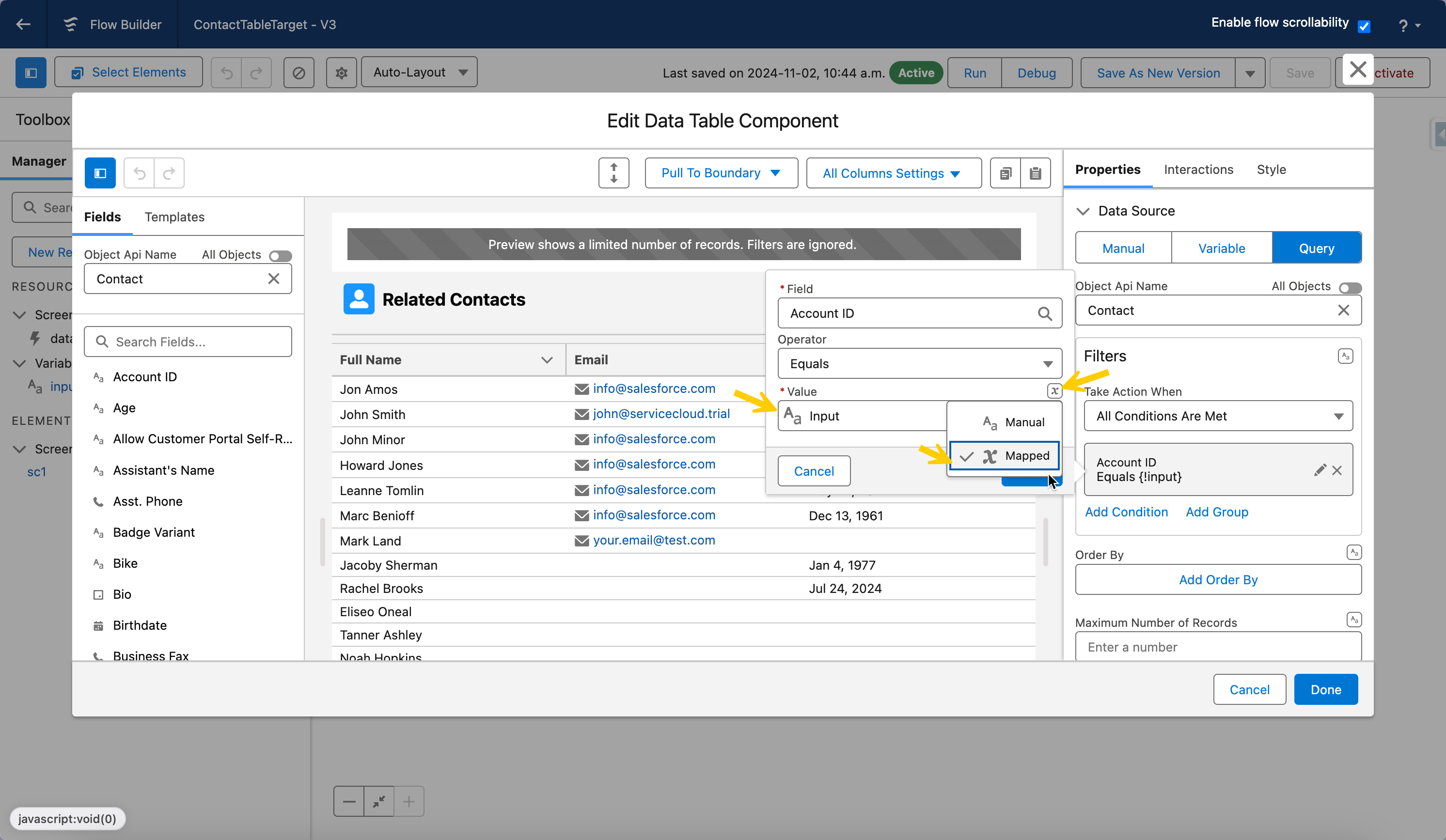
* Let's say you want to display a data table of Contacts related to the Account ID passed from the first flow.
* **Filter the Data:**
* Configure a Query Data Source and filter by the Account ID equal to the input text variable created in step 1.
***
## Passing a Full Record Between Flows
Sometimes you need to pass an entire Salesforce record to the target flow, not just its ID. This saves the target flow from running its own query to get the record data.
1. **Prepare the Target Flow**
* Create a Record Variable (not a Text variable) for the object type you want to receive (e.g., Account, ServiceAppointment).
* Set the variable as Available for Input.
2. **Configure the Input Variable in the Source Flow**
* In the Open Flow Dialog interaction, add an input variable.
* Name: The exact API name of the record variable in the target flow.
* Type: Select Salesforce Object.
* Object API Name: Enter the object's API name (e.g., Account, ServiceAppointment).
* Value: Reference the record variable from your source flow. If the value picker forces you to drill into individual fields, click the {a} icon to switch to expression mode and type the reference manually (e.g., {!myAccountRecord}).
3. **Use the Record in the Target Flow**
* The record variable in the target flow now contains the full record, including all the fields queried in the source flow.
* You can reference its fields directly in screen components, decisions, or assignments — no need for an additional Get Records element.
{% hint style="info" %}
#### Tip
The record passed to the target flow contains only the fields that were queried or assigned in the source flow. If the target flow needs fields that weren't included, add them to the original Get Records query or use a separate Get Records in the target flow
{% endhint %}
***
## Passing an Apex-Defined Variable Between Flows
Flows that use Apex-defined types (custom Apex classes) can pass these types to other flows via the Custom type.
1. **Prepare the Target Flow**
* Create a variable of the Apex-defined type you want to receive.
* Set the variable as Available for Input.
2. **Configure the Input Variable in the Source Flow**
* In the Open Flow Dialog interaction, add an input variable.
* Name: The exact API name of the variable in the target flow.
* Type: Select Custom. A text field appears below the dropdown.
* In the text field, enter the Apex class name (e.g., MyApexClass or MyNamespace.MyApexClass for managed packages).
* Value: Reference the Apex-defined variable from your source flow.
3. **Use the Variable in the Target Flow**
* The target flow receives the full Apex-defined object. Reference its properties as you would with any Apex-defined variable in Flow Builder.
{% hint style="warning" %}
#### Info
The Custom type is supported but behavior may vary depending on the specific Apex class. Test with your specific class before deploying to production. If you run into issues, [contact Avonni support](/flow/help/support-and-troubleshooting.md)
{% endhint %}
***
## **Final Thought**
Following these steps will enable smooth data transfer between the two flows, ensuring that essential information is accessible and utilized effectively. Remember, correctly configuring variables (respecting the same name) and their accessibility settings is critical to successfully passing values between flows.
---
# Agent Instructions
This documentation is published with GitBook. GitBook is the documentation platform designed so that both humans and AI agents can read, navigate, and reason over technical content effectively. Learn more at gitbook.com.
## Querying This Documentation
If you need additional information that is not directly available in this page, you can query the documentation dynamically by asking a question.
Perform an HTTP GET request on the current page URL with the `ask` query parameter, and the optional `goal` query parameter:
```
GET https://docs.avonnicomponents.com/flow/tutorials/interactions/how-to-pass-an-input-variable-from-one-flow-to-another.md?ask=&goal=
```
`ask` is the immediate question: it should be specific, self-contained, and written in natural language.
`goal` is optional and describes the broader end goal you are ultimately trying to accomplish on behalf of the user. GitBook uses it to tailor the answer towards what is most useful for that goal.
The response will contain a direct answer to the question and relevant excerpts and sources from the documentation.
Use this mechanism when the answer is not explicitly present in the current page, you need clarification or additional context, or you want to retrieve related documentation sections.