Timer
The Timer component lets users track elapsed time on a Flow screen, with start, pause, stop, and reset controls, and can save the recorded time back to a record.
The Timer component tracks time directly on a Flow screen. Users start, pause, stop, and reset the timer with configurable buttons, and the recorded value can be saved automatically to a record field — useful for logging time spent on tasks, cases, or other record-based work.
Overview
Configure whether the timer counts up or down, how the time is formatted, whether it starts automatically, and which controls appear. When Auto Save is enabled, stopping the timer writes the elapsed value to a chosen field on a record.

Configuration
Timer
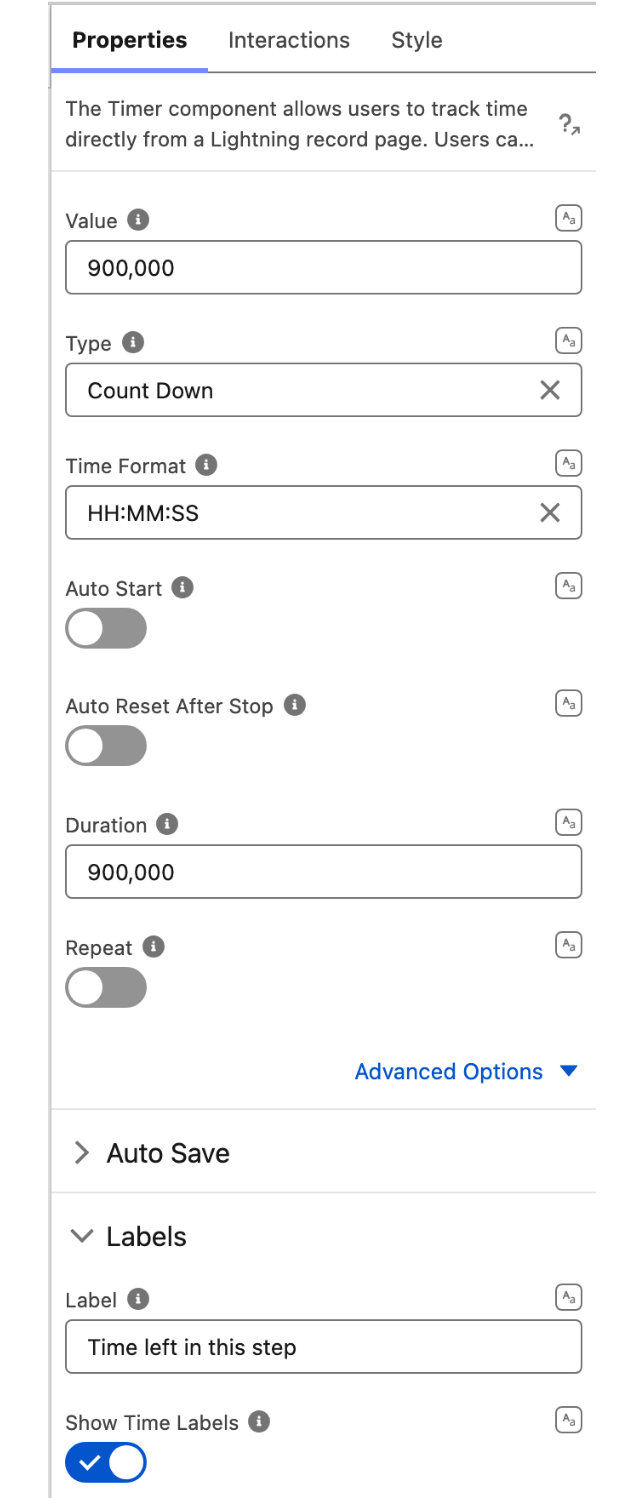
Set the core behavior of the timer:
Value sets the timer's starting value (in milliseconds).
Type controls the direction of the count: Count Up (default) or Count Down.
Time Format sets how the time is displayed: HH:MM:SS, HH:MM, MM:SS, HH, MM, SS, or Custom.
Custom Time Format defines the display pattern using
hh,mm,ss, andmstokens separated by:or.(for examplehh:mm:ss.ms). Requires Time Format = Custom.Auto Start starts the timer automatically when the screen renders.
Auto Reset After Stop resets the timer to its starting value each time it is stopped.
Duration sets how long the timer runs, in milliseconds.
Repeat restarts the timer when it reaches the duration. Requires Duration.
Interval sets how often the display updates, in milliseconds. (Advanced)

Auto Save
Persist the recorded time to a record when the timer stops:
Auto Save On Stop saves the timer value automatically when the timer is stopped.
Object API Name is the object whose record will be updated.
Field is the field the timer value is written to. Requires Auto Save On Stop.
Record Id identifies the record to update. Requires Field.
Labels
Show Time Labels displays descriptive labels beside the time units.
Time Labels Format sets the label style: Short or Long. Requires Show Time Labels.
Time Labels Position places the labels Top or Bottom. Requires Show Time Labels.
Buttons
Buttons Position places the controls Left, Right, Top, or Bottom.
Start Button Label and Start Button Icon customize the start control.
Pause Button Label and Pause Button Icon customize the pause control.
Disable Pause Button hides the ability to pause. (Advanced)
Stop Button Label and Stop Button Icon customize the stop control.
Display Reset Button shows a reset control, customized with Reset Button Label and Reset Button Icon.
Use Cases
Case handling — log the time an agent spends on a case and save it to a field on stop.
Timed tasks — count down a fixed duration and repeat it for interval-based work.
Self-service — let users track time on a guided Flow without leaving the screen.
Interactions
The Timer emits an event on each control action, so a Flow interaction can react to it:
On Start
Triggered when the timer is started.
On Pause
Triggered when the timer is paused.
On Stop
Triggered when the timer is stopped.
On Save
Triggered when the timer value is saved.
Styling
The Style tab exposes the following categories: Margin, Padding, Border, Background, Horizontal Alignment, and Flow Dialog (spacing and appearance when the component is shown inside a Flow dialog).
Output Variables
Value
Number
The current timer value, in milliseconds.
Value On Pause
Number
The timer value captured at the moment it was paused.
State
Text
The current state of the timer (for example running, paused, stopped).
Record
Record
The record updated when the timer is stopped (when Auto Save is enabled).
Troubleshooting
The timer doesn't save — confirm Auto Save On Stop is enabled and that Object API Name, Field, and Record Id all resolve to a writable record and field.
Count Down never ends — set a Duration; without one, there is no target for the countdown to reach.
The display isn't what I expect — when using a custom pattern, check Custom Time Format uses only the
hh,mm,ss,mstokens and that Time Format is set to Custom.
Last updated
Was this helpful?