> For the complete documentation index, see [llms.txt](https://docs.avonnicomponents.com/llms.txt). Markdown versions of documentation pages are available by appending `.md` to page URLs; this page is available as [Markdown](https://docs.avonnicomponents.com/experience-cloud/properties-panel/interactions/download.md).
# Download
Let users download a file directly from an Avonni component — from a direct URL or a Salesforce file (Content Document) — without leaving the page.
## Overview
The **Download Interaction** allows users to retrieve files directly from Avonni components (like [**Data Tables**](https://docs.avonnicomponents.com/experience-cloud/experience-components/ax-data-table.md) or [**Lists**](https://docs.avonnicomponents.com/experience-cloud/experience-components/ax-list.md)) within an Experience Site. This streamlines the user journey by eliminating the need to navigate to or visit record pages or file libraries to access important documents.
***
## Configuration
To enable file downloads within your Experience Site, follow these steps:
{% stepper %}
{% step %}
#### **Prepare Your Component**
Add an Avonni Data Table or List to your Experience Cloud page and map it to the records you wish to display. Ensure your data source includes the Content Document ID or a File URL
{% endstep %}
{% step %}
#### **Add the Interaction**
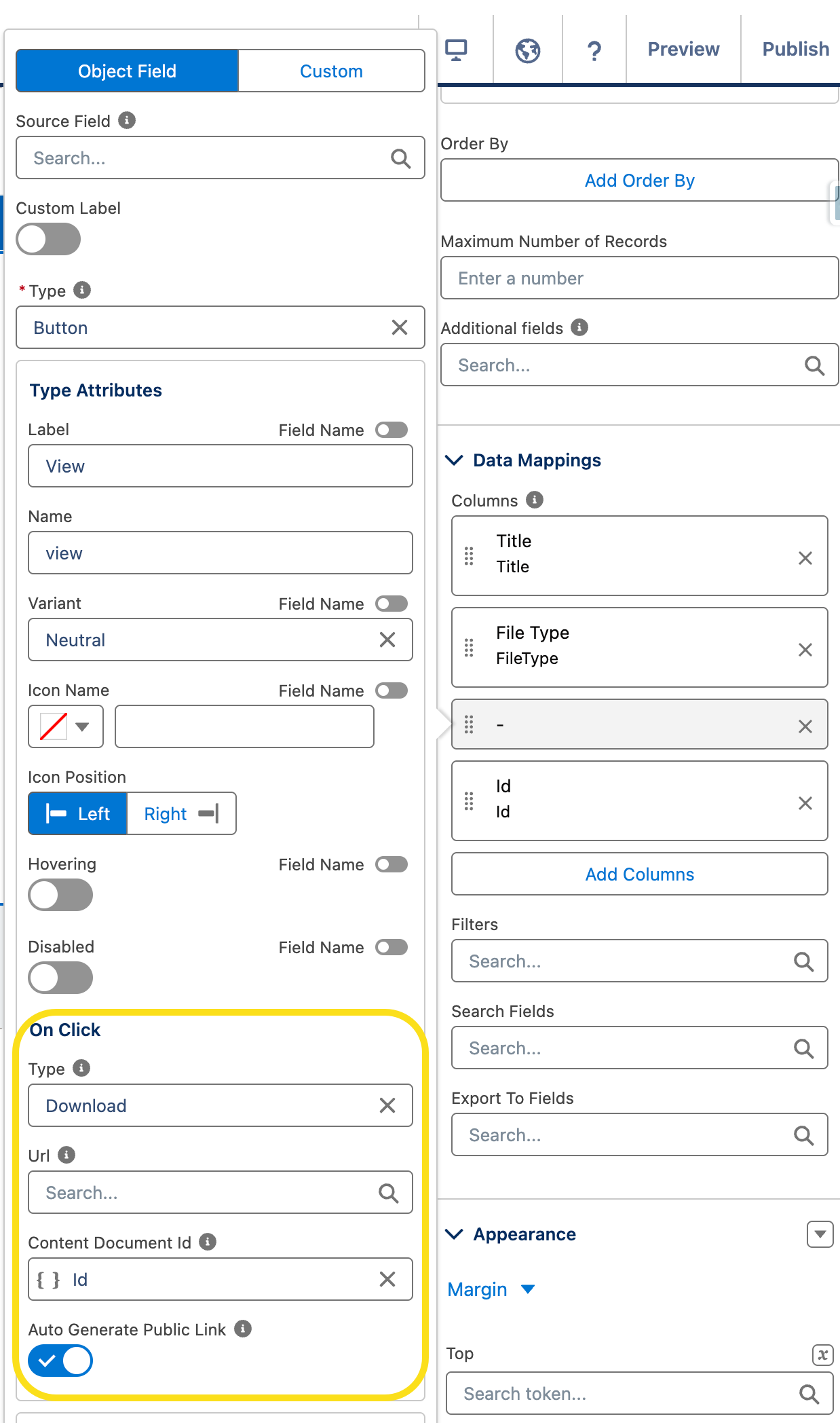
Open the component's interaction setting in the property panel — Experience Builder has no separate Interactions tab; the setting lives inside the editor for the event you're wiring up — and select **Download** as the interaction **Type**. In a Data Table, you can trigger this in two ways:
* **As a Row Action**: Add the download command to the action menu (the dropdown at the end of a row). This is best for keeping the table clean.
* **As a Button Column**: Create a dedicated column with a "Download" button or icon for every record. This is best for high visibility and quick access
{% endstep %}
{% step %}
#### **Define the Source**
* **Url**: Use this to reference a specific external link or a custom URL field.
* **Content Document Id**: Use this to reference Salesforce files directly.
> **Note**: If both are provided, the **Url** attribute takes precedence.
> {% endstep %}
{% step %}
#### **Enable Public Access (Crucial)**
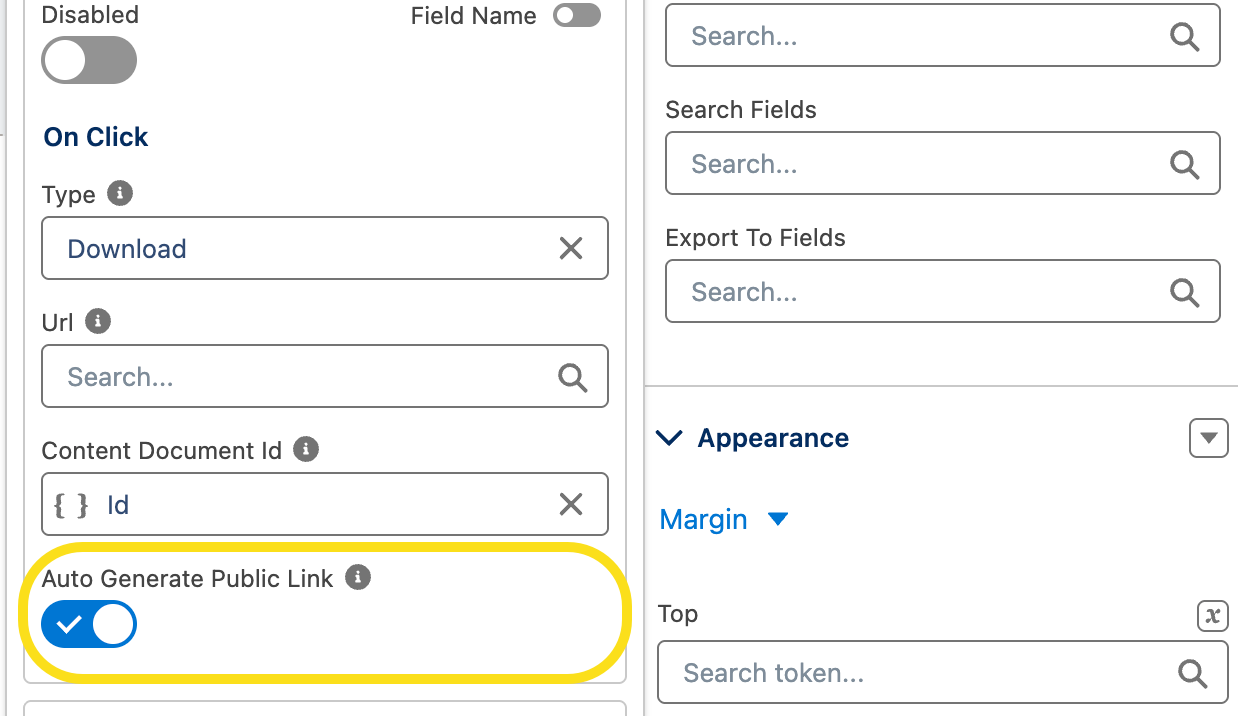
When using **Content Document Id**, you will see a toggle for **Auto Generate Public Link**.
* Always enable this for Experience Sites if you want external users (customers or partners) to download files without encountering permission roadblocks.
{% endstep %}
{% endstepper %}
***
## Example
Imagine a Partner Portal where partners view a list of "Available Marketing Assets." By adding the Download interaction to a Data Table:
* Partners see a "Download" icon next to each asset.
* By enabling **Auto Generate Public Link**, the partner can instantly download the PDF or image, even if the file was originally uploaded to an internal-only library.
***
## Important Considerations
* **Permissions**: While **Auto Generate Public Link** helps with visibility, ensure your Experience Cloud profile has basic access to the objects being displayed.
* **Url Accuracy**: If using the **Url** method, ensure the link is a "Direct Download" link rather than a preview page to ensure a smooth user experience
---
# Agent Instructions
This documentation is published with GitBook. GitBook is the documentation platform designed so that both humans and AI agents can read, navigate, and reason over technical content effectively. Learn more at gitbook.com.
## Querying This Documentation
If you need additional information that is not directly available in this page, you can query the documentation by asking a question.
Perform an HTTP GET request on the following URL with the `ask` and `goal` query parameters:
```
GET https://docs.avonnicomponents.com/experience-cloud/properties-panel/interactions/download.md?ask=&goal=
```
`ask` is the immediate question: it should be specific, self-contained, and written in natural language.
`goal` is what the user is ultimately trying to achieve, the reason they need the answer. Sharing it helps GitBook give you a better, more relevant answer. A goal is most helpful when it describes the outcome the user wants rather than restating the question. For example, with `ask=how do I create an API token`, a goal like `automate deployments from our CI pipeline` lets GitBook tailor the answer to that use case.
The response will contain a direct answer to the question and relevant excerpts and sources from the documentation.
Use this mechanism when the answer is not explicitly present in the current page, you need clarification or additional context, or you want to retrieve related documentation sections.